Exponential Functions!
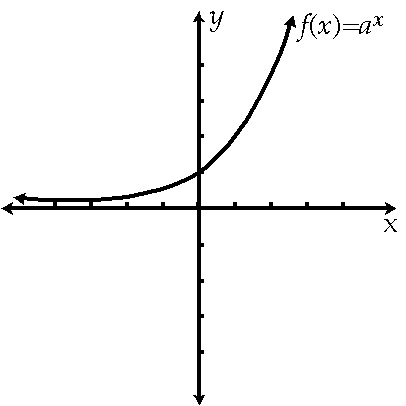
Properties
Domain:
Range:
Roots:
Asymptotes:
Periodicity:
All Real Numbers
All Positive Real Numbers
None. The graph never crosses the x-axis.
x=0
Description
y = abx. a is the growth factor, b
is the base, and the exponent must be a variable. Exponential functions have a constant growth factor. If the growth factor is greater than 1, the function will have exponential growth. If the growth factor is less than 1, the function will have exponential decay. This type of equation is a series of multiplications. For example, y = abx
is the same as y = a*b*b*b*b when x is equal to 4. Due to the repeated multiplication this type of equation has a growth rate that
accelerates extremely quickly. For a fixed change in input (x), the output (y) gets multiplied by a fixed amount.
In exponential functions
a should not equal 0 and b should be
greater than 1.
Reflection
To reflect the graph over the x-axis multiply a by -1. You can see this in action by looking at Example 1.
Example 1:
y = 2(4)x

y = -2 (4)x

To reflect the graph over the y-axis take the inverse of b. You can see this in action by looking at Example 2.
y = 2(4)x
y = 2 (¼)x

Real World Applications
- Width of paper as it is being folded
- Compounded Interest Rates (Ex. Credit Cards)
- Population Growth
- Carbon Dating
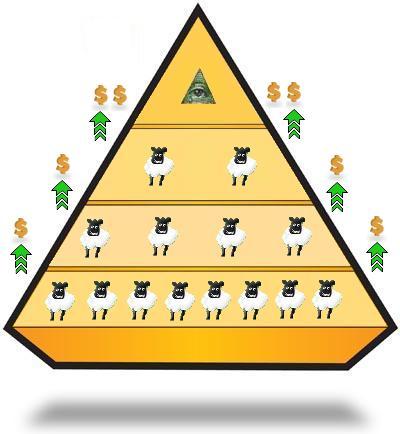
- Pyramid/Ponzi Scheme
Representations
Picture
Words
Each time you fold the paper the width of the paper doubles.
Table
x
1
2
3
4
5
y
2
4
8
16
32
Formula - f(x) = b(a^x)
Graph (see top of page)
How To Graph:
Problems
- Question) Given a sheet of paper that is .2mm thick, how thick would the folded paper be if you were to fold it 5 times? Find an exponential equation that models the folding of the paper and use that equation to find the thickness of the paper after 50 folds.
Answer) a) 6.4 mm
b) .2*2^x = y
c) 225179981368524.8mm - Question) A group of fruit flies colonize a peach. The initial colony is made up of 5 flies. If each day the population triples in size how many flies will their be on the 10th day? Use an exponential function to find your answer.
Answer) P = 5*3^x . On the 10th day x = 10 so P = 5*3^10 = 295245
Standards
CCSS.MATH.CONTENT.HSF.LE.A.1 Distinguish between situations that can be modeled with linear functions and with exponential functions.
CCSS.MATH.CONTENT.HSF.LE.A.1.A Prove that linear functions grow by equal differences over equal intervals, and that exponential functions grow by equal factors over equal intervals.
CCSS.MATH.CONTENT.HSF.LE.A.1.B Recognize situations in which one quantity changes at a constant rate per unit interval relative to another.
CCSS.MATH.CONTENT.HSF.LE.A.1.C Recognize situations in which a quantity grows or decays by a constant percent rate per unit interval relative to another.
CCSS.MATH.CONTENT.HSF.LE.A.2 Construct linear and exponential functions, including arithmetic and geometric sequences, given a graph, a description of a relationship, or two input-output pairs (include reading these from a table).
CCSS.MATH.CONTENT.HSF.LE.A.3 Observe using graphs and tables that a quantity increasing exponentially eventually exceeds a quantity increasing linearly, quadratically, or (more generally) as a polynomial function.
All of these standards can be addressed using information on this website tab. For linear, exponential, and quadratic functions, the information needed to distinguish between these functions is available on the website. These are all standards that are expected to be covered when students are learning about these three types of functions. In the classroom, students could be given this website as a reference point for them to use to learn about these types of functions. It could also be used to help students complete their assignments or study guides. Using a website such as this one gives students a way to look for themselves at the information that they need. Also, assigning a project in which students make these websites is another great way to bring their knowledge about these functions up. Because these standards are asking about growth and decay, constructing functions, observing both graphs and tables, and distinguishing between various aspects of these functions, this website is a great way to cover all of the different pieces of these standards. Each of these standards is addressed in this website.
I think that this website does an excellent job of tying together these standards to student learning. For the first standard, it wants students to learn to distinguish between different types of functions. This is done in this website in the real world applications section, as well as the properties section. Students could look at the properties listed and match them to the function they are working with. For the second, third, and fourth standards, they want students to understand that different types of functions grow at different rates. In this website, you can look at the graph for each type of function and see the difference in change between the different functions. Students could also see the formula for the function and realize the difference. As far as learning to construct different types of functions, students could use the graph examples as well as the other representations such as table to help them learn to construct the graphs. Students could also use the formulas for each function type to help with this. Finally, it wants students to observe graphs and tables of different functions and note how the function is changing and which type it is. This is done again through looking at the graph, properties, tables, and other features of a function to determine which one is the best fit.
